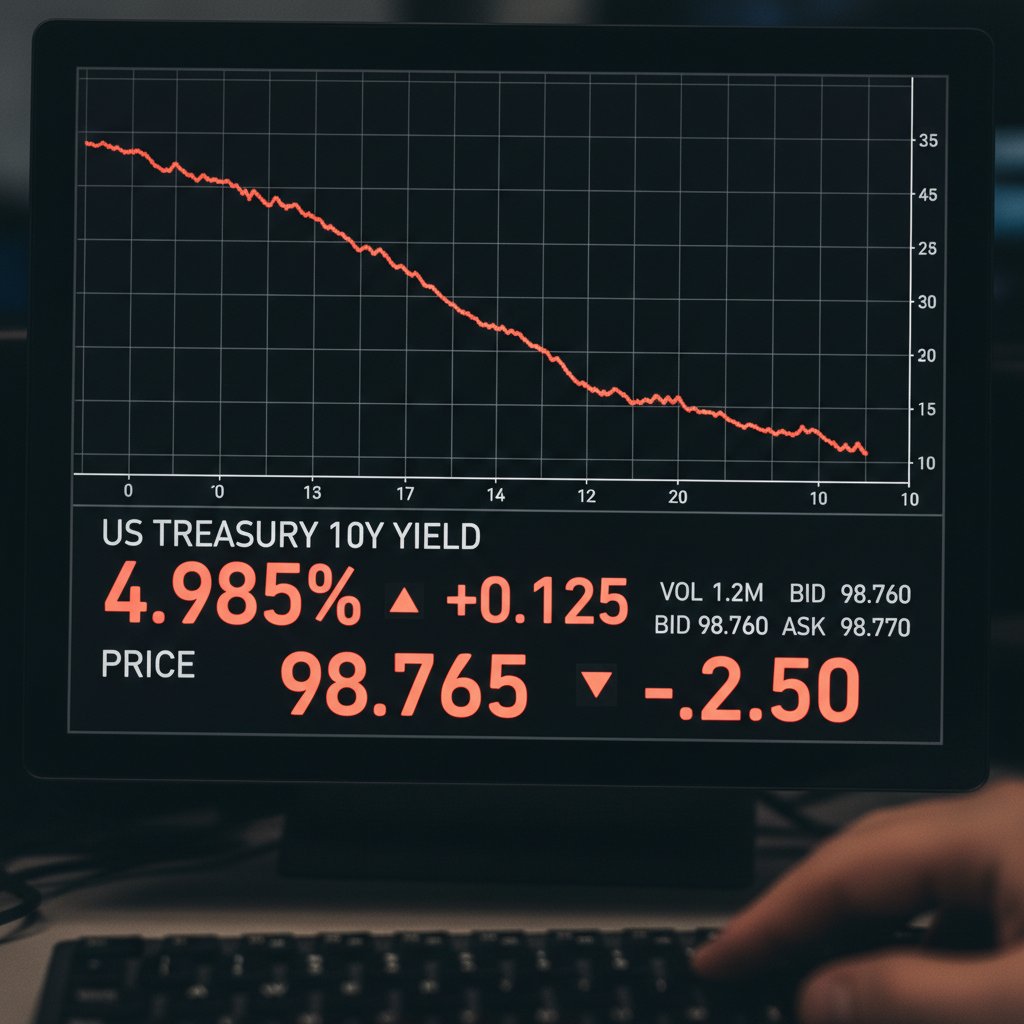
The global bond market is reeling this week as U.S. Treasuries head toward their longest losing streak in over a month. Investors are increasingly unnerved by a volatile combination of escalating geopolitical tensions in the Middle East and the persistent threat of energy-driven inflation, which has sent yields climbing across the curve.
The benchmark 10-year Treasury yield rose for a third consecutive day on Saturday, pushing past 4.35% as market participants reassessed the likelihood of the Federal Reserve maintaining higher interest rates for longer. This sell-off reflects a significant shift in sentiment from earlier in the month, when cooling economic data had briefly bolstered hopes for a more accommodative monetary policy.
Geopolitical Friction Sparks Oil Surge
The primary catalyst for the current market turbulence is the deteriorating relationship between the United States and Iran. Recent diplomatic friction and reports of naval posturing in the Strait of Hormuz have sent Brent crude prices toward the $95-per-barrel mark. Because energy costs are a major component of consumer price indices, any sustained increase in oil prices threatens to reverse the disinflationary progress made over the last six months.
Analysts at major financial institutions suggest that the bond market is now pricing in a "geopolitical premium." While Treasuries are traditionally viewed as a "safe haven" during times of war or instability, the specific nature of this conflict—centered on energy-producing regions—creates a unique paradox. The fear of inflation currently outweighs the impulse for a flight to quality, causing investors to demand higher yields to compensate for the eroding purchasing power of fixed-income returns.

The Federal Reserve’s Narrowing Path
The resurgence of inflation fears complicates the Federal Reserve’s stated goal of achieving a "soft landing." If energy prices continue to climb, the central bank may be forced to delay planned interest rate cuts or, in a worst-case scenario, consider further hikes to prevent a second wave of price increases.
The following table illustrates the recent movement in key Treasury maturities over the last 48 hours:
| Maturity | Yield (Feb 19) | Yield (Feb 21) | Change (Basis Points) |
|---|---|---|---|
| 2-Year Treasury | 4.62% | 4.71% | +9 bps |
| 10-Year Treasury | 4.24% | 4.37% | +13 bps |
| 30-Year Treasury | 4.41% | 4.52% | +11 bps |
Federal Reserve officials have remained cautious in their recent public appearances. While some governors have hinted that the current restrictive stance is sufficient, the "dot plot" of projected rates remains highly sensitive to incoming data. The market is now looking toward next week’s release of the Personal Consumption Expenditures (PCE) price index, the Fed's preferred inflation gauge, for more clarity.

Market Sentiment and Investor Strategy
Institutional investors are reacting by shortening the duration of their portfolios, moving away from long-term bonds that are most sensitive to interest rate fluctuations. "We are seeing a clear transition from a focus on economic growth to a focus on supply-side shocks," noted one senior strategist at a leading New York investment firm.
The volatility is not limited to the United States. Sovereign bond yields in Europe and Asia have also ticked upward, following the lead of the Treasury market. As the U.S. dollar strengthens alongside rising yields, emerging market economies are facing renewed pressure on their currencies, further complicating the global economic outlook.
Retail investors, meanwhile, are increasingly looking at Treasury Inflation-Protected Securities (TIPS) as a hedge against the very risks currently driving the sell-off. These instruments, which adjust their principal based on inflation rates, have seen increased inflows over the past 48 hours.

Outlook: A High-Stakes Balancing Act
The trajectory of the bond market in the coming weeks will likely depend on two factors: the temperature of the rhetoric coming out of Washington and Tehran, and the resilience of U.S. consumer spending in the face of rising energy costs.
Should the geopolitical situation stabilize, yields could quickly retreat as the market returns its focus to domestic economic fundamentals. However, if the "oil-driven inflation" narrative gains further traction, the current losing streak for Treasuries may only be the beginning of a larger structural shift in the fixed-income landscape.
For now, the mantra on trading floors is one of extreme caution. With the 10-year yield approaching critical psychological thresholds, the "worst run in a month" may soon become a defining moment for the financial markets in 2026.